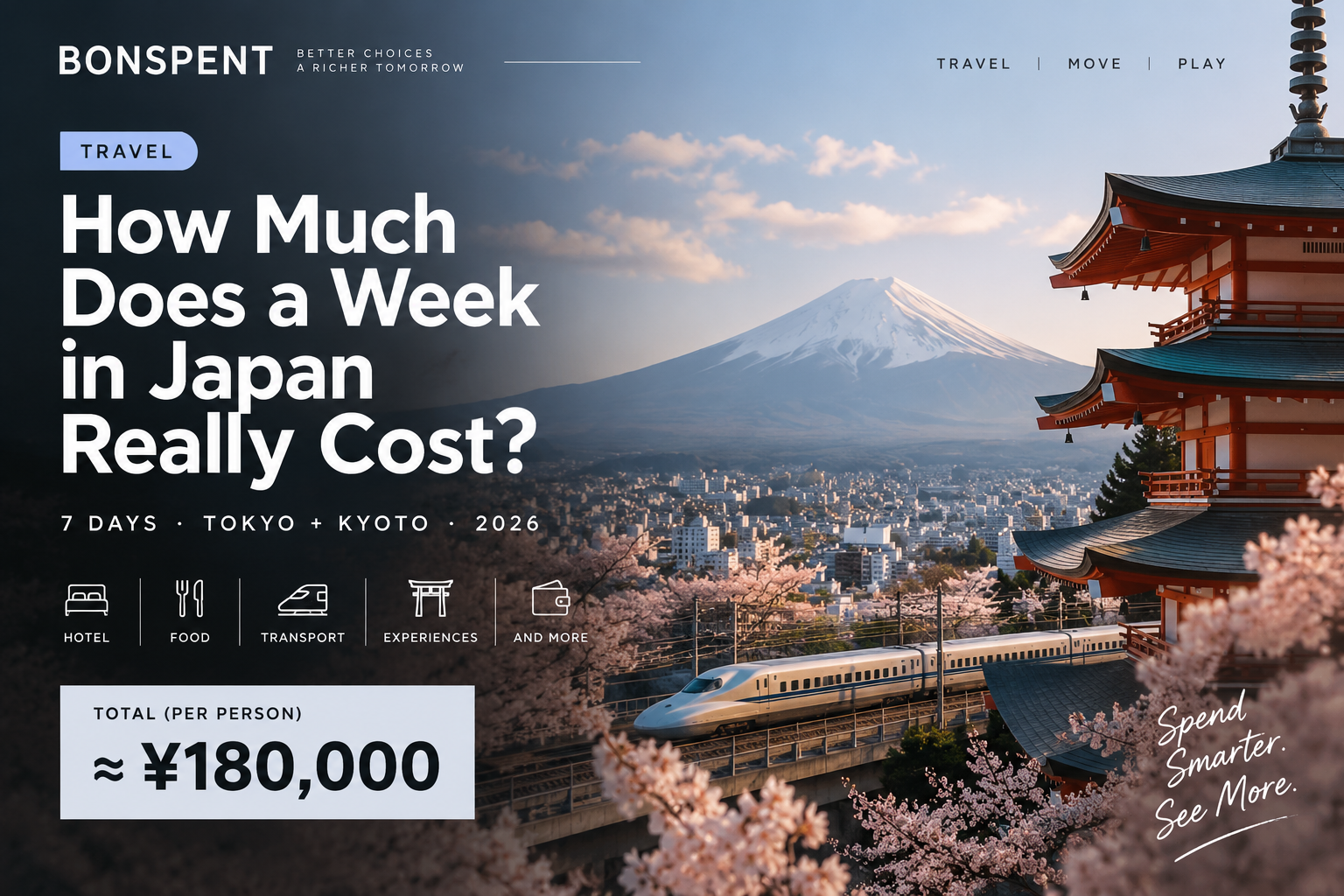
How Much Does a Week in Japan Really Cost in 2026?
A week in Japan can cost surprisingly little — or several times more — depending on where you choose to spend. For a realistic 7-day trip covering Tokyo and Kyoto, we estimate that most independent travelers should budget about ¥140,000 to ¥240,000, excluding international flights and shopping.
Our Bonspent Pick is about ¥180,000: save where spending more adds little to the trip, and spend where it meaningfully improves your time or experience.
Quick Answer
For one adult traveling for 7 days and 6 nights — 4 nights in Tokyo and 2 nights in Kyoto — our 2026 budget models look like this:
| Budget Style | Estimated Cost | What it Means | Bonspent Take |
|---|---|---|---|
| Value | ¥140–145k | Private room, affordable meals, careful transport choices | Cheapest sensible trip |
| Bonspent | ≈¥180k | Value hotels + better food + faster intercity travel | Best balance |
| Comfort | ≈¥240k | Better hotels and fewer compromises | More comfort, diminishing returns |
| Premium | ¥450k+ | Higher-end hotels, dining and upgrades | Experience-led spending |
International airfare and shopping are excluded. Airport transfers vary by arrival airport and are shown separately in our calculations.
What Our ¥180,000 Japan Budget Includes
Our Bonspent budget is not designed to make Japan as cheap as possible. It is designed to cut spending where the experience changes little, while keeping money for the parts of the trip where it matters.
For our model, we assume one adult, 7 days and 6 nights, 4 nights in Tokyo, 2 nights in Kyoto, travel between the two cities, and a normal non-peak travel period. International airfare and shopping are excluded.
| Category | Budget | What We Assumed |
|---|---|---|
| Accommodation | ¥77,852 | Business-class hotels, 4 nights Tokyo + 2 Kyoto |
| Food | ¥40,000 | Affordable breakfast/lunch + room for better dinners |
| Tokyo–Kyoto | ¥28,340 | Round-trip Nozomi reserved seats |
| Local transit | ¥7,000 | Pay-as-you-go + passes only when useful |
| Experiences | ¥12,000 | Paid attractions and experiences |
| Connectivity | ¥2,500 | eSIM / mobile data |
| Miscellaneous | ¥8,000 | Small unplanned expenses |
| Core total | ¥175,692 | Before airport transfers |
Add about ¥1,040 round trip from Haneda using the Tokyo Monorail, or about ¥4,940 round trip from Narita using the Keisei Skyliner. That brings our practical target to roughly ¥180,000.
Accommodation: The Biggest Budget Lever
Accommodation is where a Japan budget can change the fastest. But paying more for a hotel does not always improve the trip by the same amount.
For our 2026 model, we used recent market hotel rates rather than relying on a single hotel search. In July 2026, estimated pre-tax average daily rates for business hotels were ¥12,306 in Tokyo and ¥10,230 in Kyoto. City hotels were considerably higher at ¥22,434 in Tokyo and ¥17,420 in Kyoto.
As a cross-check, Kyoto’s official tourism statistics reported an ADR of ¥17,744 across 117 major hotels in July 2026.
What six nights look like after taxes
After adding Japan’s 10% consumption tax and the applicable local accommodation taxes(Tokyo, Kyoto), our six-night model comes to approximately:
| Hotel Style | Tokyo 4 Nights | Kyoto 2 Nights |
|---|---|---|
| Business / Value | ¥54,546 | ¥23,306 |
| City / Comfort | ¥99,510 | ¥39,124 |
That puts accommodation at about ¥77,852 for the Value model, compared with about ¥138,634 for the Comfort model — a difference of more than ¥60,000 over just six nights.
Bonspent Take: Save on the room. Spend on the trip.
If both options give you a clean, private room in a convenient location, spending an extra ¥60,000 on accommodation may add less to the trip than using that money for better meals, experiences or faster transportation.
That is why our ¥180,000 Bonspent budget keeps the Value-level accommodation rather than upgrading the hotel by default.
Food: Eating Cheaply Doesn’t Mean Eating Poorly
Japan is one of those destinations where keeping food costs low does not necessarily mean sacrificing the experience. Convenience-store breakfasts, beef bowls, ramen and casual restaurants can all keep individual meals relatively inexpensive — while still leaving room in the budget for more memorable dinners.
How We Built Our ¥40,000 Food Budget
Instead of assigning the same amount to every meal, our Bonspent model spends unevenly throughout the day. Breakfast and lunch are kept relatively inexpensive, while dinner gets more room for restaurants and experience-driven meals.
These are planning ranges used in our budget model, not fixed market averages.
| Meal | Typical Budget | Bonspent Approach |
|---|---|---|
| Breakfast | ¥500–1,000 | Keep it simple |
| Lunch | ¥800–1,500 | Casual local meals |
| Dinner | ¥1,500–3,000 | Spend more where it matters |
| Snacks & drinks | ¥400–800 | Flexible |
A traveler following the lower end of this pattern could eat for roughly ¥3,000–¥3,500 per day, putting a very economical week near ¥21,000–¥25,000.
Our Bonspent budget instead allocates ¥40,000 for the week. The extra room is intentional: it allows several better dinners or food experiences without requiring premium dining every day.
Bonspent Take: Don’t Optimize the Experience Out of Food
Food is a good example of why the cheapest possible trip is not always the best-value trip.
Saving ¥500 on breakfast may have almost no effect on your experience. Saving ¥2,000 on a dinner you were genuinely looking forward to might.
Spend less when the experience barely changes. Spend more when it does.
Tokyo to Kyoto: Is the Faster Shinkansen Worth It?
Transportation is one area where spending a little more can meaningfully improve a short trip.
For our 7-day itinerary, we assume a round trip between Tokyo and Kyoto on the Tokaido Shinkansen. A standard reserved-seat Nozomi fare is about ¥14,170 each way, or ¥28,340 round trip.
A cheaper option such as the Platt Kodama plan costs ¥10,960 each way on eligible Monday–Thursday departures outside peak periods, based on prices published September 1, 2026.
What Does That ¥6,420 Actually Buy You?
| Option | Round Trip | Travel Time | Bonspent Take |
|---|---|---|---|
| Kodama | ≈¥21,920 | ~3h 40m each way | Better for saving money |
| Nozomi | ≈¥28,340 | ~2h 10m each way | Better for a short trip |
The difference is roughly ¥6,420 for the round trip, but the faster train can save around three hours of total travel time across both journeys.
On a two-week trip, that trade-off may not matter much. On a 7-day trip, three additional hours in Tokyo or Kyoto are much more valuable.
The Bonspent Break-Even
Another way to look at the decision is to calculate the price of the time saved.
Paying roughly ¥6,420 more to save around three hours means you are effectively paying about ¥2,140 per hour saved.
If an extra hour of usable vacation time is worth more than ¥2,140 to you, the Nozomi upgrade makes sense. If your schedule is flexible and minimizing cost matters more, the slower option offers better financial value.
Bonspent Pick: Nozomi for a 7-day trip.
This is exactly the kind of upgrade we are willing to pay for: the additional cost is relatively small compared with the total trip budget, while the benefit — more usable time at the destination — is meaningful.
Local Transportation: Don’t Automatically Buy a Pass
Japan’s public transportation is efficient, but that does not mean every unlimited pass is automatically a good deal.
For our 7-day budget, we set aside ¥7,000 for local transportation in Tokyo and Kyoto. Rather than assuming a pass for every day, our model uses a mix of pay-as-you-go fares and passes only when the itinerary makes them worthwhile.
The key is simple: buy a pass based on how you will actually travel, not because unlimited travel sounds convenient.
Tokyo Subway Pass: When Does It Pay Off?
| Tokyo Subway Ticket | Price | Approx. Break-Even |
|---|---|---|
| 24-hour | ¥1,000 | roughly 6 rides |
| 48-hour | ¥1,500 | roughly 5 rides per day |
| 72-hour | ¥2,000 | roughly 4 rides per day |
The Tokyo Subway Ticket can be excellent value on sightseeing-heavy days. But if you only make a few subway trips — or use JR lines and other operators that are not covered — paying individually may cost less.
A pass therefore becomes more valuable when your itinerary is dense and transit-heavy, not simply because you are staying in Tokyo.
Kyoto Works the Same Way
Kyoto’s Subway & Bus 1-Day Pass costs ¥1,100, while a standard city bus ride costs ¥230.
Compared with the standard ¥230 city-bus fare alone, about five covered rides would roughly match the ¥1,100 pass price. The actual break-even point varies when subway rides and other covered services are included. For a day involving several temples and attractions spread across the city, that can be easy to reach. For a slower day focused on one neighborhood, it may not be.
Why We Budget ¥7,000
Our ¥7,000 local transportation allowance is not based on buying unlimited passes every day. It leaves room for regular train, subway and bus fares while selectively using passes on days when they actually save money.
This also prevents a common travel-budget mistake: buying a pass first and then changing your itinerary just to “get your money’s worth.”
Bonspent Pick: Pay as you go by default. Buy a pass when your itinerary crosses the break-even point.
Convenience has value, but unlimited travel is only a bargain when you actually use it.
Experiences: Don’t Optimize the Fun Out of Your Trip
Our model allocates about ¥12,000 for paid attractions and experiences.
This is deliberately not the lowest possible number.
Japan has plenty to do for free: neighborhoods, parks, shrines, shopping districts, viewpoints and simply exploring Tokyo or Kyoto can fill a large part of a trip without admission fees.
But there is a point where aggressive budgeting becomes counterproductive.
You traveled to Japan to experience Japan.
For example, adult admission to teamLab Planets starts at ¥3,600, depending on the date. Museums, observation decks, gardens, temples and other attractions can add more.
Skipping every paid attraction might reduce the spreadsheet total, but it can also reduce what you actually get from the trip.
That is false economy: saving money in a way that noticeably weakens the experience you paid to travel for in the first place.
Bonspent Pick: Keep roughly ¥10,000–15,000 available for experiences and decide what is genuinely worth paying for.
Airport Transfers: Haneda vs Narita Changes the Real Cost
International airfare is excluded from our ¥180,000 budget because flight prices vary dramatically depending on where you are traveling from.
But the airport you arrive at still affects your ground transportation cost.
For a simple comparison, the Tokyo Monorail between Haneda Airport and Hamamatsucho costs about ¥520 each way.
That makes a basic round trip about:
¥520 × 2 = ¥1,040
The Keisei Skyliner between Narita Airport and Ueno costs about ¥2,470 each way, making the equivalent round trip:
¥2,470 × 2 = ¥4,940
That is a difference of roughly ¥3,900 before considering where your hotel is actually located.
The Cheapest Flight Is Not Always the Cheapest Trip
This matters when comparing airfare.
Imagine a Narita flight is ¥3,000 cheaper than a similar Haneda flight.
Looking only at airfare, Narita wins.
But once the additional airport transportation is included, that advantage may disappear — and Haneda may also save meaningful travel time.
This is why we prefer comparing the true trip cost, rather than airfare in isolation.
Bonspent Pick: Compare flight price + airport transfer cost + travel time before deciding which Tokyo airport offers better value.
Connectivity and Miscellaneous Costs
Small expenses are easy to leave out of travel budgets, which is why our model includes them explicitly.
We allocate:
- ¥2,500 for connectivity
- ¥8,000 for miscellaneous expenses
These are planning allowances rather than market averages.
Connectivity could include an eSIM or another mobile-data option.
The miscellaneous allowance covers the small expenses that inevitably appear during a trip: lockers, small fees, forgotten toiletries, an extra train ride, drinks, convenience purchases or other unplanned costs.
These expenses rarely determine whether a trip is affordable, but ignoring them makes a budget look more precise than it really is.
A realistic budget should leave some room for being wrong.
Smart Saving vs False Economy
The cheapest possible Japan trip is not necessarily the best-value Japan trip.
That distinction is central to how we built this budget.
| Smart Saving | False Economy |
|---|---|
| Choosing a clean business hotel | Staying far away just to save a small amount |
| Eating inexpensive local meals | Skipping food experiences you actually wanted |
| Paying individually for light transit days | Buying passes you won’t fully use |
| Spending less on ordinary breakfasts | Cutting every memorable meal |
| Comparing airport total cost | Choosing airfare based only on the ticket price |
| Paying more when it saves meaningful time | Paying for upgrades with little practical benefit |
The goal is not:
How cheaply can you visit Japan?
The better question is:
Where does spending more actually improve the trip?
Value vs Comfort: Where Does the Extra Money Go?
Our Value model comes to roughly ¥140,000–145,000, while the Comfort model is closer to ¥240,000.
That is almost a ¥100,000 difference.
But the experience does not necessarily improve by the same proportion.
Much of the additional Comfort budget goes toward accommodation.
Our accommodation model rises from roughly ¥77,900 for business-class hotels to about ¥138,600 for city-hotel accommodation.
Better rooms, more space, better facilities and potentially better locations certainly have value.
But consider how much time you actually spend awake in your hotel room during a 7-day sightseeing trip.
For many independent travelers, doubling accommodation spending will not double the quality of the overall trip.
That is why our Bonspent budget stays relatively close to the Value model for accommodation while spending more selectively elsewhere.
Save on the Room. Spend on the Trip.
That sentence summarizes our ¥180,000 model.
We would rather stay in a good-value private room and use the difference for:
- faster intercity transportation,
- better dinners,
- experiences,
- and flexibility during the trip.
That does not make expensive hotels a bad purchase.
It simply means their value depends heavily on how much you personally value the hotel experience itself.
What About a Premium Japan Trip?
Once higher-end hotels, premium dining, upgraded transportation and more paid experiences enter the calculation, a 7-day Japan budget can easily exceed ¥450,000, even before international airfare and shopping.
At this level, however, a single number becomes increasingly misleading.
Luxury hotel rates vary enormously by property, season and location. Premium dining has an even wider range.
So ¥450,000+ should be treated as a starting scenario rather than a precise average.
This is also where the purpose of spending changes.
The Value traveler spends primarily to access the destination.
The Premium traveler may be spending on the hotel, restaurant or transportation experience itself.
Neither is inherently better.
They are buying different things.
So, How Much Should You Budget for a Week in Japan?
For our specific itinerary — one adult, 7 days and 6 nights, Tokyo and Kyoto, outside major peak periods — we would use these planning numbers:
| Travel Style | Recommended Budget |
|---|---|
| Value | ¥140,000–145,000 |
| Bonspent Pick | ≈¥180,000 |
| Comfort | ≈¥240,000 |
| Premium | ¥450,000+ |
Remember that these figures exclude international airfare and shopping.
If your goal is simply to visit Japan for as little as reasonably possible, around ¥140,000 can work within our assumptions.
If you want better hotels and fewer compromises, moving toward ¥240,000 gives you substantially more flexibility.
But for many independent travelers, we think the most interesting point sits between those two.
The Bonspent Verdict
Our pick: about ¥180,000 for one week in Japan, excluding international airfare and shopping.
Not because ¥180,000 is a magic number.
It is the result of asking a different question.
Instead of trying to minimize every category, we looked at where additional spending is likely to meaningfully change the trip.
Our answer is:
Save where the experience barely changes. Spend where it does.
Stay in a good-value hotel.
Eat inexpensive meals when inexpensive food is already good.
Pay more for meals you will remember.
Use transit passes only when the math works.
And on a short trip, consider paying a little more when it buys back several hours of your vacation.
That is what makes the approximately ¥180,000 budget our Bonspent Pick.
Because the cheapest trip is not always the best value.
And neither is the most expensive one.
How We Calculated This Budget
This article uses our Bonspent Value Methodology, which evaluates a decision across five dimensions:
Money · Time · Experience · Utility · Ease
Rather than comparing sticker prices alone, we look at the true cost of a choice and what the traveler receives in return.
For this Japan budget, that includes accommodation rates and taxes, transportation prices, time differences between travel options, food spending assumptions, paid experiences and miscellaneous costs.
Prices and market data were collected or checked in 2026. Some prices vary by travel date, booking conditions, location and availability, so the figures in this article should be treated as planning estimates rather than guaranteed prices.
Learn more: Bonspent Methodology
Data Sources
For this analysis, we prioritize official sources and primary data where available, supplemented by market datasets when an official market average is not available.
Key sources include:
- HotelBank / MetroEngines — July 2026 hotel ADR estimates
- Kyoto City Tourism Association — July 2026 hotel market data
- Tokyo Metropolitan Government — accommodation tax
- Kyoto City — accommodation tax
- JR Central / JR Tokai Tours — Platt Kodama fares and travel time
- Tokyo Metro — Tokyo Subway Ticket
- Kyoto Municipal Transportation Bureau — Subway & Bus 1-Day Pass
- Kyoto Municipal Transportation Bureau — City Bus Fares
- Tokyo Monorail — Haneda fares
- Keisei Electric Railway — Skyliner fares
- Japan National Tourism Organization — budget travel reference
- teamLab Planets — admission pricing
Data checked: September 2026
One Comment
Comments are closed.