Cheapest Months to Visit Japan in 2026: When Is Japan Actually Best Value?
If you’re looking for the cheapest time to visit Japan, June is the winner so far in our 2026 Tokyo–Kyoto hotel dataset. But if you’re looking for the best overall value, our pick is February.
That difference matters.
Japan is not cheapest when the weather is best. And the most expensive months aren’t necessarily bad value either.
For this analysis, BONSPENT compared confirmed 2026 business-hotel prices in Tokyo and Kyoto with climate conditions, seasonal experiences and major Japanese holiday periods.
The goal isn’t simply to find the lowest price.
It’s to answer a more useful question:
When do you get the most Japan for your money and time?
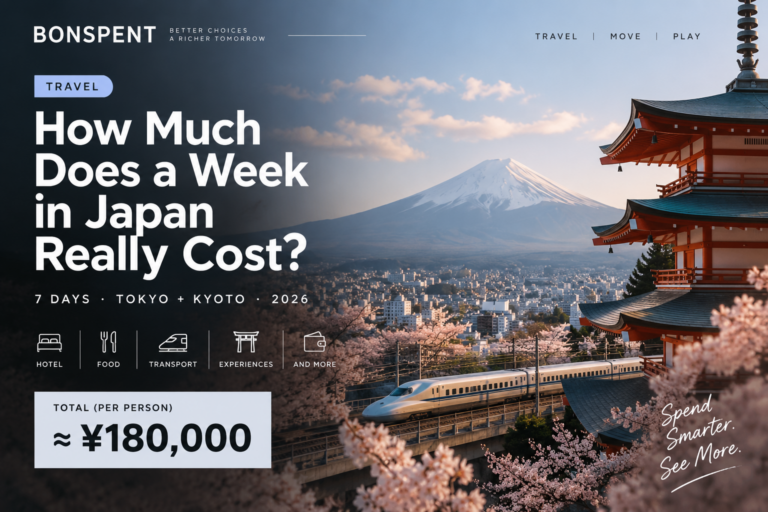
If you’re planning the total budget rather than just choosing your travel dates, start with our realistic 7-day Japan budget for 2026.
Quick Answer: The Best Months to Visit Japan for Value
Here’s our current verdict:
| If you want… | Our pick | Why |
|---|---|---|
| 🏆 Best overall value | February | Low hotel prices, dry weather, lower seasonal pressure |
| 💰 Cheapest hotels so far | June | Lowest Tokyo–Kyoto average in confirmed Jan–Jul data |
| 🌸 Best unique experience | April | Cherry blossoms can justify the premium |
| 🌤 Best spring compromise | May | Great weather and lower prices than April — outside Golden Week |
| ☀️ Budget summer trip | July | Cheap hotels, but heat reduces sightseeing comfort |
| 🍁 Experience-first trip | Autumn | Excellent weather and foliage, but seasonal demand can be high |
There is no single “best month” for every traveler.
The cheapest month is only good value if you’re comfortable with what you’re giving up to get the lower price.
The BONSPENT 12-Month Japan Value Calendar
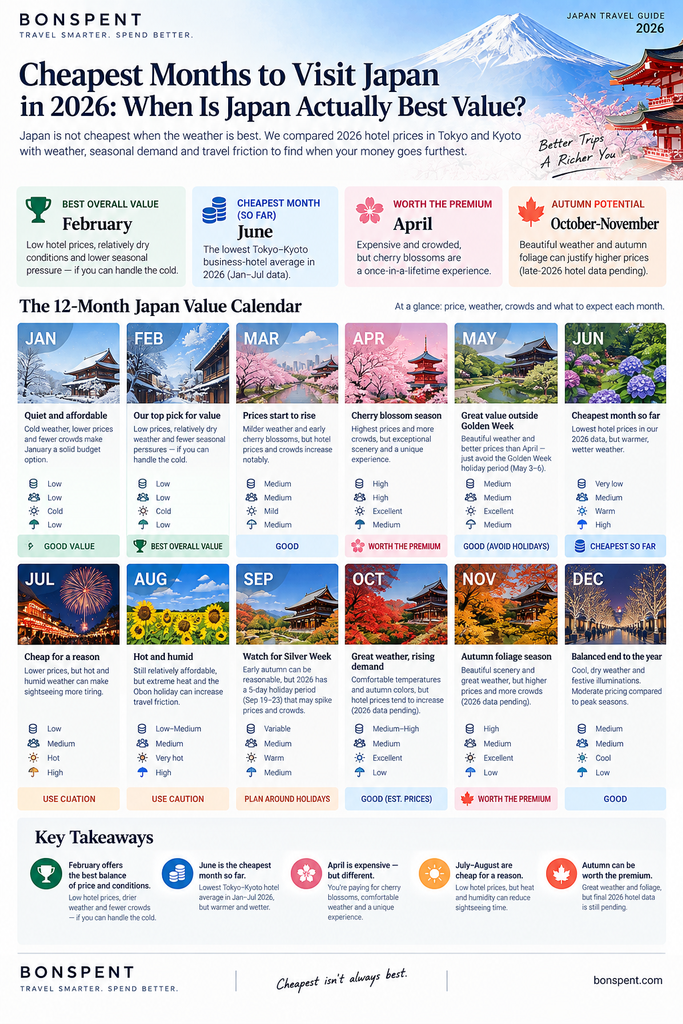
Data note: Hotel-price rankings in this article use confirmed January–July 2026 estimated settled ADR data. Later months are discussed using climate normals, official holiday dates and seasonal travel patterns; we will update the analysis as finalized 2026 hotel data becomes available.
So, What Is the Cheapest Month to Visit Japan?
Based on confirmed January–July 2026 data, June has been the cheapest month so far for business hotels across our Tokyo–Kyoto sample.
The pattern is surprisingly clear.
| Month | Tokyo | Kyoto | Tokyo–Kyoto Average |
|---|---|---|---|
| January | ¥12,550 | ¥9,773 | ¥11,162 |
| February | ¥13,307 | ¥9,641 | ¥11,474 |
| March | ¥15,670 | ¥16,969 | ¥16,320 |
| April | ¥17,802 | ¥20,308 | ¥19,055 |
| May | ¥14,890 | ¥15,278 | ¥15,084 |
| June | ¥11,890 | ¥9,616 | ¥10,753 |
| July | ¥12,306 | ¥10,230 | ¥11,268 |
Tokyo and Kyoto figures are estimated settled ADRs for business hotels, on a tax-exclusive equivalent basis, compiled by HotelBank from MetroEngines Research data. They are useful as a consistent indicator of market price pressure — not as guaranteed room prices available to every traveler.
Tokyo 2026 hotel ADR data — HotelBank / MetroEngines
Kyoto 2026 hotel ADR data — HotelBank / MetroEngines
The April average was approximately 77% higher than June’s.
That’s a meaningful difference for a multi-night trip.
But price only tells half the story.
June Is the Cheapest — But There’s a Trade-Off
June’s low hotel prices come with Japan’s early-summer rainy season.
Tokyo’s 1991–2020 climate normals show:
June mean temperature: 21.9°C
June precipitation: 167.8 mm
Compare that with February:
February mean temperature: 6.1°C
February precipitation: just 56.5 mm.
The Japan Meteorological Agency defines these climate normals using 30 years of observations from 1991–2020.
Japan Meteorological Agency climate normals
For a Tokyo–Kyoto itinerary built around walking, temples, neighborhoods and outdoor sightseeing, weather affects more than comfort.
It affects usable travel time.
Rain can mean slower movement, more indoor stops, additional transport and less flexibility.
So our verdict on June is:
💰 BONSPENT CHEAPEST PICK — JUNE
Best for: travelers who prioritize hotel savings and don’t mind rain or humidity.
June wins on money.
It doesn’t win overall.
Why February Is Our Best-Value Month
February is where the numbers get interesting.
The Tokyo–Kyoto business-hotel average in our dataset was approximately ¥11,474, compared with June’s ¥10,753.
That’s only about ¥721 more per night.
Yet the weather trade-off is very different.
Tokyo normally receives just 56.5 mm of precipitation in February compared with 167.8 mm in June. February is also considerably sunnier in Tokyo: the JMA normal is 170.4 sunshine hours versus 124.2 in June.
The obvious downside is temperature.
Tokyo’s February mean is only 6.1°C.
So this isn’t a universal recommendation.
But for travelers comfortable sightseeing in a winter coat, February offers a compelling combination:
Low prices. Relatively dry weather. Fewer peak-season pressures.
🏆 BONSPENT PICK — FEBRUARY
Best for: budget-conscious travelers who don’t mind cold weather.
This is why February beats June on overall value even though June is cheaper.
April Is Expensive — But Different
April demonstrates the biggest flaw in ranking travel months by price alone.
In our January–July dataset, April was the most expensive month.
The Tokyo–Kyoto business-hotel average reached approximately ¥19,055, versus ¥10,753 in June.
That’s a huge premium.
But the product isn’t the same.
Spring brings comfortable sightseeing conditions and one of Japan’s most distinctive seasonal experiences: cherry blossoms.
Someone traveling specifically to see sakura isn’t paying extra for the same trip they could take in June.
They’re paying for an experience that doesn’t exist in June.
That’s why BONSPENT separates cheap from value.
🌸 WORTH THE PREMIUM — CHERRY BLOSSOM SEASON
Best for: travelers for whom seeing Japan in bloom is a major reason for the trip.
If you’re indifferent to cherry blossoms, the premium is harder to justify.
If seeing sakura is on your bucket list, the calculation changes completely.
We’ll test that premium directly in a separate analysis:
Is Cherry Blossom Season in Japan Worth the Price Premium?
May May Be the Spring Sweet Spot
For travelers who want spring weather without the full April price premium, May deserves serious consideration.
Our Tokyo–Kyoto business-hotel average fell from approximately ¥19,055 in April to ¥15,084 in May.
But there’s one enormous caveat:
Golden Week.
In 2026, Japan has holidays from May 3–6, with May 6 becoming a substitute holiday. The Japanese government specifically identifies this period as part of an extended holiday stretch.
Official 2026 Japanese holiday calendar
Domestic travel demand can make availability, crowds and prices very different from an ordinary May week.
So our recommendation isn’t:
Visit Japan in May.
It’s:
🌤 BEST SPRING COMPROMISE — MAY OUTSIDE GOLDEN WEEK
Great weather, lower hotel pressure than April and fewer compromises — if you choose the dates carefully.
This is an important distinction.
Month-level averages can hide date-level price traps.
July: Cheap for a Reason
July remained inexpensive in our confirmed dataset, with a Tokyo–Kyoto average of approximately ¥11,268.
That’s barely above February.
But Tokyo’s climate normal rises to a 25.7°C monthly mean, with a normal daily maximum of 29.9°C.
And remember: those are averages.
A Tokyo–Kyoto trip usually involves substantial walking, outdoor attractions and time spent moving between stations and sights.
Heat can reduce the amount of sightseeing you’re willing to do in a day.
That creates an invisible travel cost:
You saved money on the hotel but lost usable travel time.
☀️ CHEAP FOR A REASON — JULY
Best for: heat-tolerant travelers, summer festival fans and travelers prioritizing accommodation cost.
Cheap doesn’t mean bad.
It means you should understand what you’re trading for the discount.
What About August?
August needs more caution.
It’s hot, humid and overlaps with major domestic summer travel patterns including Obon.
More importantly for this analysis, August 2026 hotel ADR is not yet finalized in the same dataset we’re using for January–July.
HotelBank explicitly distinguishes August onward as current-sales estimates rather than finalized settled values.
So we won’t rank August against confirmed months using a number that may still change.
Our current classification is simply:
Potentially affordable, but high weather and holiday friction.
We’ll update the price ranking once finalized data is available.
September 2026 Has a Specific Price Trap
September deserves special attention this year.
Japan’s official 2026 holiday calendar has:
September 21 — Respect for the Aged Day
September 22 — Holiday
September 23 — Autumnal Equinox Day
September 22 becomes a holiday because it falls between two national holidays. Together with the weekend, the Japanese government identifies this as a five-day holiday period.
That means:
A September trip and a Silver Week trip are not necessarily the same product.
Hotels, trains and attractions can face very different demand during the holiday period.
So if you’re targeting September for value, date selection matters more than the monthly average.
October and November: When Experience May Justify the Price
We don’t yet have finalized full-autumn 2026 hotel ADR data comparable with January–July.
So we’re deliberately not assigning October or November a finalized price ranking yet.
What we can measure is the weather.
Tokyo’s climate normals show a mean temperature of 18.0°C in October and 12.5°C in November. November precipitation falls to 96.3 mm, compared with 224.9 mm in September and 234.8 mm in October.
That makes late autumn attractive for walking-heavy sightseeing.
Then there’s foliage.
Like cherry blossoms, autumn colors change what you’re buying.
A traveler visiting Kyoto specifically for fall foliage isn’t necessarily making a poor value decision by paying more.
They’re choosing experience over minimum price.
🍁 EXPERIENCE-FIRST PICK — AUTUMN
Potentially worth paying more for excellent sightseeing conditions and seasonal scenery.
We’ll update the price side of this verdict once finalized late-2026 hotel data is available.
So Which Month Should You Choose?
Think about the trip you actually want.
Choose February if you want the best current balance of price, dry weather and lower seasonal pressure.
Choose June if minimizing hotel cost matters most and rain doesn’t bother you.
Choose April if cherry blossoms are a major reason you’re going.
Choose May outside Golden Week if you want comfortable spring sightseeing without paying the full April premium.
Consider July if you’re comfortable with heat and want relatively inexpensive accommodation.
Consider autumn if weather and foliage matter more than getting the lowest possible price.
That’s a much more useful way to choose a travel month than simply asking:
“When is Japan cheapest?”
How BONSPENT Calculated Value
BONSPENT doesn’t define value as the lowest possible price.
Our framework compares:
WHAT YOU GET ÷ WHAT YOU GIVE UP
For this analysis, we considered five factors:
Money — Tokyo and Kyoto business-hotel ADR.
Time — weather and congestion that can reduce usable sightseeing time.
Experience — seasonal experiences such as cherry blossoms and autumn foliage.
Utility — how suitable the month is for a typical Tokyo–Kyoto sightseeing trip.
Ease — weather friction, holiday pressure and booking difficulty.
Our Bonspent Value Score is a decision model, not an objective scientific ranking.
Hotel prices, temperatures, precipitation and holiday dates are measurable data.
Experience and Ease involve editorial judgment.
That’s why we show the inputs rather than pretending a single score can objectively define the “best” month.
Read more about How BONSPENT Measures Value.
Final Verdict
June is the cheapest month we’ve measured so far in confirmed 2026 Tokyo–Kyoto business-hotel data. February is our current pick for best overall value.
The difference captures exactly what BONSPENT is trying to measure.
June saves slightly more money.
February gives up some of that saving in exchange for much drier weather and easier sightseeing conditions.
April costs dramatically more — but gives travelers an experience February and June cannot.
So don’t simply choose the cheapest month to visit Japan.
Choose the cheapest month that still gives you the Japan trip you actually want.
That’s when your money — and your time — are better spent.
Data Sources & Update Policy
Hotel pricing: MetroEngines Research data compiled by HotelBank. January–July 2026 figures used here are finalized estimated settled ADRs on a tax-exclusive equivalent basis.
HotelBank — Tokyo 2026 hotel data
HotelBank — Kyoto 2026 hotel data
Climate: Japan Meteorological Agency 1991–2020 climatological normals.
Japan Meteorological Agency — Climate Normals
National holidays: Cabinet Office / Government of Japan official 2026 holiday calendar.
Cabinet Office — Japan’s 2026 National Holidays
Data checked: September 15, 2026.
Update policy: BONSPENT will update late-2026 hotel-price conclusions as finalized monthly data becomes available.
One Comment
Comments are closed.